Chromium Bearing Aquamarine, Nasarawa State, Nigeria
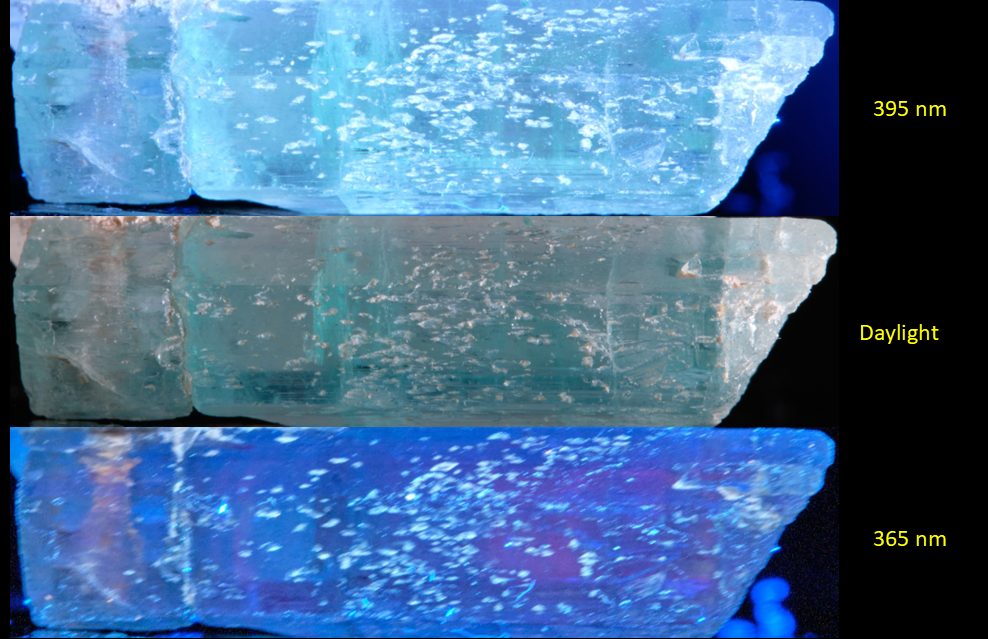
I find beryl specimens irresistible, especially emerald, aquamarine and red beryl. This very nice specimen of aquamarine on quartz was sold to me as “Nigerian Vanadium Emerald” which would imply a geochemistry including chromium. Indeed, the piece does present bands of red fluorescence under UV light, as expected for chromium. The UV images also show areas that are UV-inert, suggesting Vanadium and Iron substitution, as both exhibit strong absorption in the UV spectrum.
According to Feral (2019), the light blue color component is due to traces of divalent iron (Fe2+), while the light green color component is derived from trace amounts of both chromium and vanadium [1]. To quote the author of the citation, “These gems can be accurately regarded as an intermediary between aquamarine and emerald, and a more appropriate name for such a hybrid would be ‘chromium-bearing aquamarine.”
The piece exhibits strong pleochroism under polarized light, going from saturated, light sky blue to an unsaturated (almost colorless) greenish blue. The geochemical continuity between The Cr-, Vn- and Fe- bands offers valuable mineralogical context, elevating this piece beyond aesthetic value into the realm of interest y collectors of the beryl suite. The quantities of beryl produced from the Nasawara deposits are generally considered small and the reserves are limited.
Dimensions: 45 x 20 x18 mm; Crystal: 30 x 8 x 7 mm.
[1] Feral, Kirk. 2019. Masters of Green: Chromium and Vanadium (Part Two). Gemmology Today - Fingerprint File. June 2019.